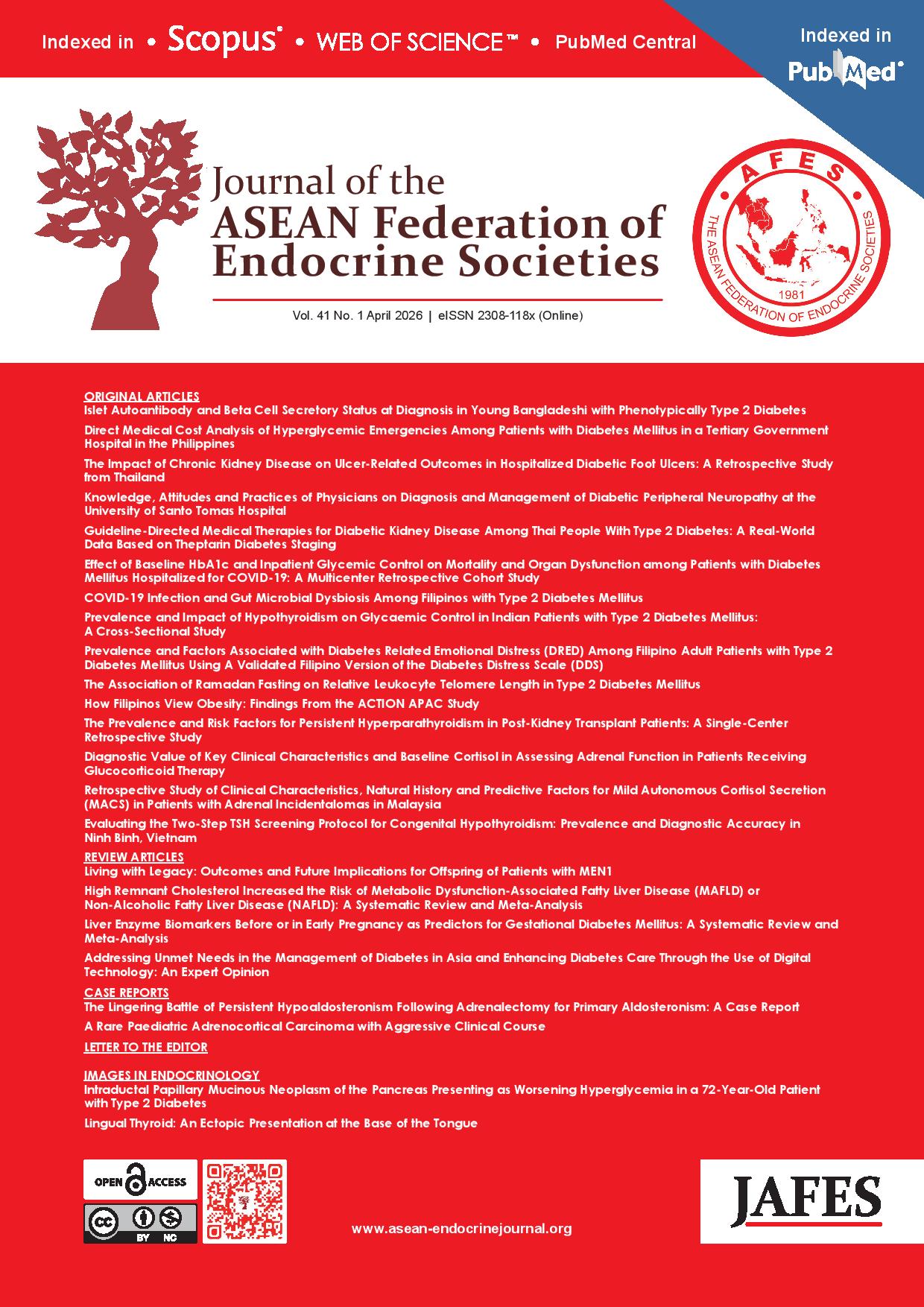
Effect of Baseline HbA1c and Inpatient Glycemic Control on Mortality and Organ Dysfunction among Patients with Diabetes Mellitus Hospitalized for COVID-19: A Multicenter Retrospective Cohort Study
DOI:
https://doi.org/10.15605/jafes.041.01.5089Keywords:
COVID-19, diabetes mellitus, glycemic control, mortalityAbstract
Background. Individuals with diabetes mellitus (DM) show increased susceptibility to COVID-19 infection with higher risk for severe disease and mortality.
Objectives. We investigated whether glycemic-related factors may affect the outcomes of patients with DM hospitalized due to COVID-19.
Methodology. This is a multicenter retrospective cohort study under the initiative of the Philippine College of Endocrinology, Diabetes, and Metabolism involving eight training hospitals in the Philippines from January 2021 to January 2022. Patients with DM hospitalized due to COVID-19 were included. Multiple binary logistic regression was done to determine whether baseline glycemic control based on glycosylated hemoglobin (HbA1c) and inpatient glycemic control based on capillary blood glucose are associated with composite poor clinical outcome of mortality and end-organ dysfunction.
Results. Among 1,093 patients, 54% had HbA1c >7%. Both poor baseline glycemic (AOR 1.41, p= 0.017) and poor inpatient glycemic control (AOR 2.6, p<0.001) were associated with composite poor clinical outcome of mortality and end-organ dysfunction. HbA1c >7% increased the odds of poor inpatient control (OR = 3.10, 95% CI: 2.32–4.17, p < 0.001), even after adjusting for steroid use.
Conclusion. Poor inpatient glycemic control has greater effect on mortality and end-organ dysfunction than baseline glycemic control. However, baseline HbA1c >7% is predictive of poor inpatient glycemic control. Measures to optimize glycemic control both in the long term and during hospitalization will improve clinical outcomes for DM patients with COVID-19.
Downloads
References
Huang I, Lim MA, Pranata R. Diabetes mellitus is associated with increased mortality and severity of disease in COVID-19 pneumonia: A systematic review, meta-analysis, and meta-regression. Diabetes Metab Syndr. 2020;14(4):395-403. https://pubmed.ncbi.nlm.nih.gov/32334395/ https://www.ncbi.nlm.nih.gov/pmc/articles/PMC7162793/ https://doi.org/10.1016/j.dsx.2020.04.018
Kumar A, Arora A, Sharma P, et al. Is diabetes mellitus associated with mortality and severity of COVID-19? A meta-analysis. Diabetes Metab Syndr. 2020;14(4):535-45. https://pubmed.ncbi.nlm.nih.gov/32408118/ https://www.ncbi.nlm.nih.gov/pmc/articles/PMC7200339/ https://doi.org/10.1016/j.dsx.2020.04.044
Bode B, Garrett V, Messler J, et al. Glycemic characteristics and clinical outcomes of COVID-19 patients hospitalized in the United States. J Diabetes Sci Technol. 2020;14(4):813-21. https://pubmed.ncbi.nlm.nih.gov/32389027/ https://www.ncbi.nlm.nih.gov/pmc/articles/PMC7673150/ https://doi.org/10.1177/1932296820924469
Cariou B, Hadjadj S, Wargny M, et al. Phenotypic characteristics and prognosis of inpatients with COVID-19 and diabetes: The CORONADO study. Diabetologia. 2020;63(8):1500-15. https://pubmed.ncbi.nlm.nih.gov/32472191/ https://www.ncbi.nlm.nih.gov/pmc/articles/PMC7256180/ https://doi.org/10.1007/s00125-020-05180-x
Edrada EM, Lopez EB, Villarama JB, et al. First COVID-19 infections in the Philippines: A case report. Trop Med Health. 2020;48:21. https://pubmed.ncbi.nlm.nih.gov/32308532/ https://www.ncbi.nlm.nih.gov/pmc/articles/PMC7154063/ https://doi.org/10.1186/s41182-020-00203-0
Haw NJL, Uy J, Sy KTL, Abrigo MRM. Epidemiological profile and transmission dynamics of COVID-19 in the Philippines. Epidemiol Infect. 2020;148:e204. https://pubmed.ncbi.nlm.nih.gov/32928322/ https://www.ncbi.nlm.nih.gov/pmc/articles/PMC7506175/
https://doi.org/10.1017/S0950268820002137
World Health Organization. Philippines Coronavirus Disease 2019 (COVID-19) Situation Report #93. 2022. Accessed July 7, 2025. https://www.who.int/docs/default-source/wpro---documents/countries/philippines/emergencies/covid-19/who_phl_sitrep_93_covid-19.pdf
National Task Force against COVID-19. National Action Plan Against COVID-19: Phase III. https://wrd.unwomen.org/sites/default/files/2023-02/PHILIPPINES_National-Action-Plan-against-COVID19.pdf
Healthcare Professionals Alliance Against COVID-19. Unified COVID-19 Algorithms version 4. https://psmid.org/wp-content/uploads/2025/10/Unified-COVID-19-Algorithms-Version-4_Final.pdf
Pelle MC, Zaffina I, Provenzano M, et al. COVID-19 and diabetes—Two giants colliding: From pathophysiology to management. Front Endocrinol (Lausanne). 2022;13:974540. https://pubmed.ncbi.nlm.nih.gov/36060943/ https://www.ncbi.nlm.nih.gov/pmc/articles/PMC9437522/ https://doi.org/10.3389/fendo.2022.974540
ElSayed NA, Aleppo G, Aroda VR, et al. Classification and diagnosis of diabetes: Standards of care in diabetes—2023. Diabetes Care. 2023;46(Suppl 1):S19-S40. https://pubmed.ncbi.nlm.nih.gov/36507649/ https://www.ncbi.nlm.nih.gov/pmc/articles/PMC9810477/
https://doi.org/10.2337/dc23-S002
Maher JM, Markey JC, Ebert-May D. The other half of the story: Effect size analysis in quantitative research. CBE Life Sci Educ. 2013;12(3):345-51. https://pubmed.ncbi.nlm.nih.gov/24006382/ https://www.ncbi.nlm.nih.gov/pmc/articles/PMC3763001/ https://doi.org/10.1187/cbe.13-04-0082
Allison PD. Measures of fit for logistic regression. 2014. Corpus ID: 13909621.
Tjur T. Coefficients of determination in logistic regression models—A new proposal: The coefficient of discrimination. Am Stat. 2009. https://doi.org/10.1198/tast.2009.08210 Corpus ID: 121927418
American Diabetes Association Professional Practice Committee. Glycemic goals and hypoglycemia: Standards of care in diabetes—2024. Diabetes Care. 2024;47(Suppl 1):S111-S125. https://pubmed.ncbi.nlm.nih.gov/38078586/ https://www.ncbi.nlm.nih.gov/pmc/articles/PMC10725808/ https://doi.org/10.2337/dc24-S006
Goldberg PA, Bozzo JE, Thomas PG, et al. “Glucometrics”—Assessing the quality of inpatient glucose management. Diabetes Technol Ther. 2006;8(5):560-9. https://pubmed.ncbi.nlm.nih.gov/17037970/ https://doi.org/10.1089/dia.2006.8.560
World Health Organization. The Asia-Pacific perspective: Redefining obesity and its treatment. Sydney: Health Communications Australia; 2000. https://iris.who.int/server/api/core/bitstreams/53228dc6-9520-421b-b5a2-f826967090cb/content
Singer M, Deutschman CS, Seymour CW, et al. The third international consensus definitions for sepsis and septic shock (Sepsis-3). JAMA. 2016;315(8):801-10. https://pubmed.ncbi.nlm.nih.gov/26903338/ https://www.ncbi.nlm.nih.gov/pmc/articles/PMC4968574/ https://doi.org/10.1001/jama.2016.0287
World Health Organization. Clinical management of COVID-19: Interim guidance. 2020. https://www.who.int/publications/i/item/clinical-management-of-covid-19/
Lin W. The association between body mass index and glycohemoglobin (HbA1c) in the US population's diabetes status. Int J Environ Res Public Health. 2024;21(5):517. https://pubmed.ncbi.nlm.nih.gov/38791732/ https://www.ncbi.nlm.nih.gov/pmc/articles/PMC11121031/ https://doi.org/10.3390/ijerph21050517
Gupta M, Gupta T, Gupta T. Physician-visit frequency and its impact on glycemic control in people with type 2 diabetes: Quantifying care acceptance parameters from retrospective electronic health record data. Cureus. 2024;16(12):e76527. https://pubmed.ncbi.nlm.nih.gov/39877765/ https://www.ncbi.nlm.nih.gov/pmc/articles/PMC11772562/ https://doi.org/10.7759/cureus.76527
Xu W, Mak IL, Zhang R, et al. Optimizing the frequency of physician encounters in follow-up care for patients with type 2 diabetes mellitus: A systematic review. BMC Prim Care. 2024;25(1):41. https://pubmed.ncbi.nlm.nih.gov/38279105/ https://www.ncbi.nlm.nih.gov/pmc/articles/PMC10811944/ https://doi.org/10.1186/s12875-024-02277-9
Qu F, Shi Q, Wang Y, et al. Visit-to-visit glycated hemoglobin A1c variability in adults with type 2 diabetes: A systematic review and meta-analysis. Chin Med J (Engl). 2022;135(19):2294-2300. https://pubmed.ncbi.nlm.nih.gov/35952315/ https://www.ncbi.nlm.nih.gov/pmc/articles/PMC9771337/ https://doi.org/10.1097/CM9.0000000000002073
Zhu NA, Reichert S, Harris SB. Limitations of hemoglobin A1c in the management of type 2 diabetes mellitus. Can Fam Physician. 2020;66(2):112-4. https://pubmed.ncbi.nlm.nih.gov/32060191/ https://www.ncbi.nlm.nih.gov/pmc/articles/PMC7021345/
KDIGO Diabetes Work Group. KDIGO 2022 clinical practice guideline for diabetes management in chronic kidney disease. Kidney Int. 2022;102(5S):S1-S127. https://pubmed.ncbi.nlm.nih.gov/36272764/ https://doi.org/10.1016/j.kint.2022.06.008
Novida H, Soelistyo SA, Cahyani C, et al. Factors associated with disease severity of COVID-19 in patients with type 2 diabetes mellitus. Biomed Rep. 2022;18(1):8. https://pubmed.ncbi.nlm.nih.gov/36570802/ https://www.ncbi.nlm.nih.gov/pmc/articles/PMC9764056/
https://doi.org/10.3892/br.2022.1590
Floyd JS, Walker RL, Kuntz JL, et al. Association between diabetes severity and risks of COVID-19 infection and outcomes. J Gen Intern Med. 2023;38(6):1484-92. https://pubmed.ncbi.nlm.nih.gov/36795328/ https://www.ncbi.nlm.nih.gov/pmc/articles/PMC9933797/
https://doi.org/10.1007/s11606-023-08076-9
Sardu C, D’Onofrio N, Balestrieri ML, et al. Hyperglycaemia on admission to hospital and COVID-19. Diabetologia. 2020;63(11):2486-7. https://pubmed.ncbi.nlm.nih.gov/32632527/ https://www.ncbi.nlm.nih.gov/pmc/articles/PMC7335920/ https://doi.org/10.1007/s00125-020-05216-2
Zhu L, She ZG, Cheng X, et al. Association of blood glucose control and outcomes in patients with COVID-19 and pre-existing type 2 diabetes. Cell Metab. 2020;31(6):1068-77.e3. https://pubmed.ncbi.nlm.nih.gov/32369736/ https://www.ncbi.nlm.nih.gov/pmc/articles/PMC7252168/ https://doi.org/10.1016/j.cmet.2020.04.021
Bhatti JM, Raza SA, Shahid MO, et al. Association between glycemic control and the outcome in hospitalized patients with COVID-19. Endocrine. 2022;77(2):213-20. https://pubmed.ncbi.nlm.nih.gov/35596836/ https://www.ncbi.nlm.nih.gov/pmc/articles/PMC9123611/
https://doi.org/10.1007/s12020-022-03078-9 Liu L, Wei W, Yang K, et al. Glycemic control before admission is an important determinant of prognosis in patients with coronavirus disease 2019. J Diabetes Investig. 2021;12(6):1064-73. https://pubmed.ncbi.nlm.nih.gov/33035409/ https://www.ncbi.nlm.nih.gov/pmc/articles/PMC7675705/ https://doi.org/10.1111/jdi.13431
Windham S, Wilson MP, Fling C, et al. Elevated glycohemoglobin is linked to critical illness in COVID-19: A retrospective analysis. Ther Adv Infect Dis. 2021;8:20499361211027390. https://pubmed.ncbi.nlm.nih.gov/34249357/ https://www.ncbi.nlm.nih.gov/pmc/articles/PMC8239973/ https://doi.org/10.1177/20499361211027390
Lesniak C, Ong R, Akula MS, et al. Inpatient glycemic control and outcome of COVID-19 patients: A retrospective cohort. SAGE Open Med. 2021;9:20503121211039105. https://pubmed.ncbi.nlm.nih.gov/34422272/ https://www.ncbi.nlm.nih.gov/pmc/articles/PMC8375327/ https://doi.org/10.1177/20503121211039105
Wang B, Glicksberg BS, Nadkarni GN, Vashishth D. Evaluation and management of COVID-19-related severity in people with type 2 diabetes. BMJ Open Diabetes Res Care. 2021;9(1):e002299. https://pubmed.ncbi.nlm.nih.gov/34493495/ https://www.ncbi.nlm.nih.gov/pmc/articles/PMC8424422/ https://doi.org/10.1136/bmjdrc-2021-002299
Bhandari S, Rankawat G, Singh A, et al. Impact of glycemic control in diabetes mellitus on management of COVID-19 infection. Int J Diabetes Dev Ctries. 2020;40(3):340-5. https://pubmed.ncbi.nlm.nih.gov/32905072/ https://www.ncbi.nlm.nih.gov/pmc/articles/PMC7466921/ https://doi.org/10.1007/s13410-020-00868-7
Parthasarathy S, Chamorro-Pareja N, Kharawala A, et al. Diabetic ketoacidosis was associated with high morbidity and mortality in hospitalized patients with COVID-19 in the NYC public health system. Diabetology. 2022;3(3):36. https://doi.org/10.3390/diabetology3030036
Lombardi A, Agarwal S, Schechter C, Tomer Y. In-hospital hyperglycemia is associated with worse outcomes in patients admitted with COVID-19. Diabetes Care. 2022;45(11):2683-8. https://pubmed.ncbi.nlm.nih.gov/36041197/
https://www.ncbi.nlm.nih.gov/pmc/articles/PMC9679263/ https://doi.org/10.2337/dc22-0708
Israel A, Schäffer AA, Merzon E, et al. A calculator for COVID-19 severity prediction based on patient risk factors and number of vaccines received. Microorganisms. 2022;10(6):1238. https://pubmed.ncbi.nlm.nih.gov/35744754/ https://www.ncbi.nlm.nih.gov/pmc/articles/PMC9229599/ https://doi.org/10.3390/microorganisms10061238
Zhang Y, Li H, Zhang J, et al. The clinical characteristics and outcomes of patients with diabetes and secondary hyperglycaemia with coronavirus disease 2019: A single-centre, retrospective, observational study in Wuhan. Diabetes Obes Metab. 2020;22(8):1443-54. https://pubmed.ncbi.nlm.nih.gov/32406594/ https://www.ncbi.nlm.nih.gov/pmc/articles/PMC7273002/
https://doi.org/10.1111/dom.14086
Parolin SAEC, Stocco RB, Lopes JCK, et al. Association between inpatient glycemic variability and COVID-19 mortality: A prospective study. Diabetol Metab Syndr. 2023;15(1):185. https://pubmed.ncbi.nlm.nih.gov/37697407/ https://www.ncbi.nlm.nih.gov/pmc/articles/PMC10494398/ https://doi.org/10.1186/s13098-023-01157-z
Zhang T, Wang N, Zhu L, et al. Bidirectional relationship between glycemic control and COVID-19 and perspectives of islet organoid models of SARS-CoV-2 infection. Biomedicines. 2023;11(3):856. https://pubmed.ncbi.nlm.nih.gov/36979836/ https://www.ncbi.nlm.nih.gov/pmc/articles/PMC10045433/ https://doi.org/10.3390/biomedicines11030856
Wu C-T, Lidsky PV, Xiao Y, et al. SARS-CoV-2 infects human pancreatic β cells and elicits β cell impairment. Cell Metab. 2021;33(8):1565-76.e5. https://pubmed.ncbi.nlm.nih.gov/34081912/ https://www.ncbi.nlm.nih.gov/pmc/articles/PMC8130512/
https://doi.org/10.1016/j.cmet.2021.05.013
Philippine Genome Center. PGC SARS-CoV-2 Bulletin No. 6: First case of the new variant under Lineage B.1.1.7 detected in the Philippines. https://pgc.up.edu.ph/pgc-sars-cov-2-bulletin-no-6/
The Guardian. Manila in lockdown as Delta cases soar in Philippines. Accessed July 7, 2025. https://www.theguardian.com/world/2021/aug/09/manila-covid-lockdown-delta-cases-philippines
Li YT, Polotan FGM, Sotelo GIS, et al. Lineage BA.2 dominated the Omicron SARS-CoV-2 epidemic wave in the Philippines. Virus Evol. 2022;8(2):veac078. https://pubmed.ncbi.nlm.nih.gov/36090771/ https://www.ncbi.nlm.nih.gov/pmc/articles/PMC9452094/
https://doi.org/10.1093/ve/veac078
Healthcare Professionals Alliance Against COVID-19. Unified COVID-19 Algorithms. https://psmid.org/unified-covid-19-algorithms/
Downloads
Published
How to Cite
Issue
Section
License
Copyright (c) 2026 Mari Des San Juan, Jennifer Lourdes Ng, John Paul Martin Bagos, Marion Sarigumba, Jekrylei Cadeliña, Ronald Chua, Darius Enario, Margarita Katrina Amor Tan, Elizabeth Paz-Pacheco, Sahra May Paragas, Erick Mendoza, Maria Princess Kanapi, Cristina Chua, Cindy Ceryl Tan, Cecille Dela Paz, Karla Kristine Fernando

This work is licensed under a Creative Commons Attribution-NonCommercial 4.0 International License.
The full license text is available at: http://creativecommons.org/licenses/by-nc/3.0/legalcode.
To request permission to translate, reproduce, download, or use articles or images for commercial reuse or business purposes from the Journal of the ASEAN Federation of Endocrine Societies (JAFES), kindly complete the Permission Request for Use of Copyrighted Material Form and email jafes@asia.com or jafes.editor@gmail.com.
A written agreement will be issued to the requester once permission has been granted.