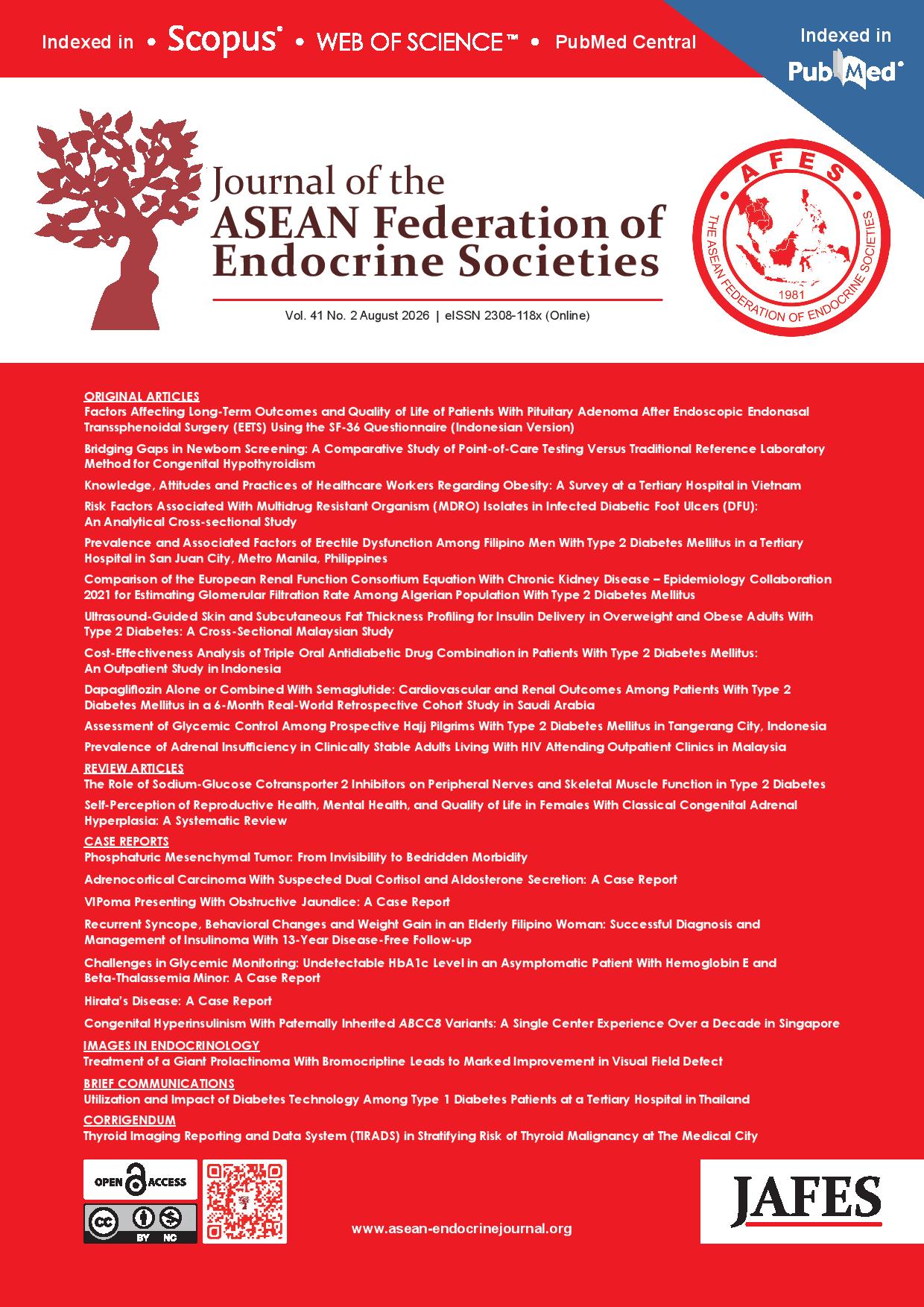
Dapagliflozin Alone or Combined With Semaglutide
Cardiovascular and Renal Outcomes Among Patients With Type 2 Diabetes Mellitus in a 6-Month Real-World Retrospective Cohort Study in Saudi Arabia
DOI:
https://doi.org/10.15605/jafes.041.02.6171Keywords:
dapagliflozin, semaglutide, type 2 diabetes, cardiovascular outcomes, renal function, real-world studyAbstract
Introduction. Type 2 diabetes mellitus (T2DM) is a growing global health concern linked to increased cardiovascular and renal complications. Two emerging therapeutic classes, sodium-glucose cotransporter-2 inhibitors (SGLT2i) and glucagon like peptide-1 receptor agonists (GLP-1 RAs), have shown independent cardiometabolic benefits. However, limited real-world data exist on the comparative impact of combining these therapies versus using SGLT2i alone.
Objective. To compare the cardiovascular and renal outcomes of dapagliflozin monotherapy versus combination therapy with once-weekly injectable semaglutide among patients with type 2 diabetes mellitus (T2DM).
Methdodology. In this retrospective cohort study, 539 adult patients with confirmed type 2 diabetes mellitus (T2DM; baseline HbA1c ≥6.5%) treated at King Abdulaziz Hospital, Al-Ahsa, were followed over six months. Patients received either dapagliflozin alone or in combination with semaglutide. Generalized Estimating Equations (GEE) were used to assess changes in glycemic control, cardiovascular events, lipid profile, and renal function, adjusting for time and sex.
Results. Both groups showed significant metabolic improvements over six months. Dapagliflozin monotherapy was associated with greater HbA1c reduction. Combination therapy was associated with higher HDL levels, improved eGFR, and a lower relative risk of heart failure (RR = 0.43, p = 0.04); the reduction in myocardial infarction risk (RR = 0.61, p = 0.13) did not reach statistical significance. No significant difference was observed in stroke risk. Most cardiovascular and renal markers improved modestly.
Conclusion. Combination therapy was associated with favorable renal outcomes and a reduction in heart failure risk, despite inferior glycemic control and a non-significant trend toward reduced myocardial infarction risk. These findings suggest potential complementary effects of SGLT2i and GLP-1 RA treatment in high-risk patients. However, due to the retrospective, non-randomized design, causal relationships cannot be inferred, and residual confounding may exist. Prospective trials are warranted to confirm these associations and guide treatment optimization.
Downloads
References
1. Saeedi P, Petersohn I, Salpea P, et al. Global and regional diabetes prevalence estimates for 2019 and projections for 2030 and 2045: Results from the International Diabetes Federation Diabetes Atlas, 9th edition. Diabetes Res Clin Pract. 2019;157:107843. https://pubmed.ncbi.nlm.nih.gov/31518657 https://doi.org/10.1016/j.diabres.2019.107843
2. Magliano DJ, Boyko EJ; IDF Diabetes Atlas 10th Edition Scientific Committee. IDF Diabetes Atlas, 10th ed. Brussels, Belgium: International Diabetes Federation; 2021. Bookshelf ID: NBK581934
3. Aljulifi MZ. Prevalence and reasons of increased type 2 diabetes in Gulf Cooperation Council countries. Saudi Med J. 2021;42(5):481-90. https://pubmed.ncbi.nlm.nih.gov/33896777 https://www.ncbi.nlm.nih.gov/pmc/articles/PMC9149705 https://doi.org/10.15537/smj.2021.42.5.20200676
4. Jarrar M, Abusalah MAH, Albaker W, et al. Prevalence of type 2 diabetes mellitus in the general population of Saudi Arabia, 2000-2020: A systematic review and meta-analysis of observational studies. Saudi J Med Med Sci. 2023;11(1):1-10. https://pubmed.ncbi.nlm.nih.gov/36909010 https://www.ncbi.nlm.nih.gov/pmc/articles/PMC9997860 https://doi.org/10.4103/sjmms.sjmms_394_22
5. American Diabetes Association. 9. Cardiovascular disease and risk management. Diabetes Care. 2017;40(Suppl 1):S75-87. https://pubmed.ncbi.nlm.nih.gov/27979896 https://doi.org/10.2337/dc17-S012
6. Alguwaihes AM, Alhozali A, Yahia MM, et al. The prevalence of cardiovascular disease in adults with type 2 diabetes mellitus in Saudi Arabia-CAPTURE study. Saudi Med J. 2023;44(1):57-66. https://pubmed.ncbi.nlm.nih.gov/36634941 https://www.ncbi.nlm.nih.gov/pmc/articles/PMC9987684 https://doi.org/10.15537/smj.2023.44.1.20220402
7. Wareham NJ. Personalised prevention of type 2 diabetes. Diabetologia. 2022;65(11):1796-803. https://pubmed.ncbi.nlm.nih.gov/35916901 https://www.ncbi.nlm.nih.gov/pmc/articles/PMC9522721 https://doi.org/10.1007/s00125-022-05774-7
8. Low Wang CC, Hess CN, Hiatt WR, Goldfine AB. Clinical update: Cardiovascular disease in diabetes mellitus: atherosclerotic cardiovascular disease and heart failure in type 2 diabetes mellitus-mechanisms, management, and clinical considerations. Circulation. 2016;133(24):2459-502. https://pubmed.ncbi.nlm.nih.gov/27297342 https://www.ncbi.nlm.nih.gov/pmc/articles/PMC4910510 https://doi.org/10.1161/CIRCULATIONAHA.116.022194
9. Kalra S. Sodium-glucose cotransporter 2 (SGLT2) inhibitors and cardiovascular disease: A systematic review. Cardiol Ther. 2016;5(2):161-8. https://pubmed.ncbi.nlm.nih.gov/27539303 https://www.ncbi.nlm.nih.gov/pmc/articles/PMC5125111 https://doi.org/10.1007/s40119-016-0069-z
10. McGurnaghan SJ, Brierley L, Caparrotta TM, et al. The effect of dapagliflozin on glycaemic control and other cardiovascular disease risk factors in type 2 diabetes mellitus: A real-world observational study. Diabetologia. 2019;62(4):621-32. https://pubmed.ncbi.nlm.nih.gov/30631892 https://doi.org/10.1007/s00125-018-4806-9
11. Furtado RH, Bonaca MP, Raz I, et al. Dapagliflozin and cardiovascular outcomes in patients with type 2 diabetes mellitus and previous myocardial infarction: Subanalysis from the DECLARE-TIMI 58 trial. Circulation. 2019;139(22):2516-27. https://pubmed.ncbi.nlm.nih.gov/30882239 https://doi.org/10.1161/CIRCULATIONAHA.119.039996
12. Goldenberg RM, Steen O. Semaglutide: Review and place in therapy for adults with type 2 diabetes. Can J Diabetes. 2019;43(2):136-45. https://pubmed.ncbi.nlm.nih.gov/30195966 https://doi.org/10.1016/j.jcjd.2018.05.008
13. Frías JP, Auerbach P, Bajaj HS, et al. Efficacy and safety of once-weekly semaglutide 2.0 mg versus 1.0 mg in patients with type 2 diabetes (SUSTAIN FORTE): A double-blind, randomised, phase 3B trial. Lancet Diabetes Endocrinol. 2021;9(9):563-74. https://pubmed.ncbi.nlm.nih.gov/34293304 https://doi.org/10.1016/S2213-8587(21)00174-1
14. Leiter LA, Bain SC, Hramiak I, et al. Cardiovascular risk reduction with once-weekly semaglutide in subjects with type 2 diabetes: A post hoc analysis of gender, age, and baseline CV risk profile in the SUSTAIN 6 trial. Cardiovasc Diabetol. 2019;18(1):73. https://pubmed.ncbi.nlm.nih.gov/31167654 https://www.ncbi.nlm.nih.gov/pmc/articles/PMC6551895 https://doi.org/10.1186/s12933-019-0871-8
15. Lunati ME, Cimino V, Bernasconi D, et al. Type 2 diabetes mellitus pharmacological remission with dapagliflozin plus oral semaglutide. Pharmacol Res. 2024;199:107040. https://pubmed.ncbi.nlm.nih.gov/38128857 https://doi.org/10.1016/j.phrs.2023.107040
16. Perkovic V, Jardine MJ, Neal B, et al. Canagliflozin and renal outcomes in type 2 diabetes and nephropathy. N Engl J Med. 2019;380(24):2295-306. https://pubmed.ncbi.nlm.nih.gov/30990260 https://doi.org/10.1056/NEJMoa1811744
17. Zhang DP, Xu L, Wang LF, Wang HJ, Jiang F. Effects of antidiabetic drugs on left ventricular function/dysfunction: Systematic review and network meta-analysis. Cardiovasc Diabetol. 2020;19(1):10. https://pubmed.ncbi.nlm.nih.gov/31969144 https://www.ncbi.nlm.nih.gov/pmc/articles/PMC6977298 https://doi.org/10.1186/s12933-020-0987
18. American Diabetes Association. 9. Pharmacologic approaches to glycemic treatment: Standards of Medical Care in Diabetes-2021. Diabetes Care. 2021;44(Suppl 1):S111-24. https://pubmed.ncbi.nlm.nih.gov/33298420 https://doi.org/10.2337/dc21-S009
19. Nauck MA, Quast DR, Wefers J, Meier JJ. GLP-1 receptor agonists in the treatment of type 2 diabetes-state-of-the-art. Mol Metab. 2021;46:101102. https://pubmed.ncbi.nlm.nih.gov/33068776 https://www.ncbi.nlm.nih.gov/pmc/articles/PMC8085572 https://doi.org/10.1016/j.molmet.2020.101102
20. Davies MJ, D'Alessio DA, Fradkin J, et al. Management of hyperglycemia in type 2 diabetes, 2018. A consensus report by the American Diabetes Association (ADA) and the European Association for the Study of Diabetes (EASD). Diabetes Care. 2018;41(12):2669-701. https://pubmed.ncbi.nlm.nih.gov/30291106 https://www.ncbi.nlm.nih.gov/pmc/articles/PMC6245208 https://doi.org/10.2337/dci18-0033
21. Frias JP, Davies MJ, Rosenstock J, et al. Tirzepatide versus semaglutide once weekly in patients with type 2 diabetes. N Engl J Med. 2021;385(6):503-15. https://pubmed.ncbi.nlm.nih.gov/34170647 https://doi.org/10.1056/NEJMoa2107519
22. Zinman B, Wanner C, Lachin JM, et al. Empagliflozin, cardiovascular outcomes, and mortality in type 2 diabetes. N Engl J Med. 2015;373(22):2117-28. https://pubmed.ncbi.nlm.nih.gov/26378978 https://doi.org/10.1056/NEJMoa1504720
23. Marso SP, Daniels GH, Brown-Frandsen K, et al. Liraglutide and cardiovascular outcomes in type 2 diabetes. N Engl J Med. 2016;375(4):311-22. https://pubmed.ncbi.nlm.nih.gov/27295427 https://www.ncbi.nlm.nih.gov/pmc/articles/PMC4985288 https://doi.org/10.1056/NEJMoa1603827
24. Intensive blood-glucose control with sulphonylureas or insulin compared with conventional treatment and risk of complications in patients with type 2 diabetes (UKPDS 33). UK Prospective Diabetes Study (UKPDS) group. Lancet. 1998;352(9131):837-53. https://pubmed.ncbi.nlm.nih.gov/9742976
25. Stratton IM, Adler AI, Neil HA, et al. Association of glycaemia with macrovascular and microvascular complications of type 2 diabetes (UKPDS 35): Prospective observational study. BMJ. 2000;321(7258):405-12. https://pubmed.ncbi.nlm.nih.gov/10938048 https://www.ncbi.nlm.nih.gov/pmc/articles/PMC27454 https://doi.org/10.1136/bmj.321.7258.405
26. Barnett AH. Impact of sodium glucose cotransporter 2 inhibitors on weight in patients with type 2 diabetes mellitus. Postgrad Med. 2013;125(5):92-100. https://pubmed.ncbi.nlm.nih.gov/24113667 https://doi.org/10.3810/pgm.2013.09.2698
27. Blundell J, Finlayson G, Axelsen M, et al. Effects of once-weekly semaglutide on appetite, energy intake, control of eating, food preference and body weight in subjects with obesity. Diabetes Obes Metab. 2017;19(9):1242-51. https://pubmed.ncbi.nlm.nih.gov/28266779 https://www.ncbi.nlm.nih.gov/pmc/articles/PMC5573908 https://doi.org/10.1111/dom.12932
28. Lean ME, Leslie WS, Barnes AC, et al. Primary care-led weight management for remission of type 2 diabetes (DiRECT): An open-label, cluster-randomised trial. Lancet. 2018;391(10120):541-51. https://pubmed.ncbi.nlm.nih.gov/29221645 https://doi.org/10.1016/S0140-6736(17)33102-1
29. Marso SP, Bain SC, Consoli A, et al. Semaglutide and cardiovascular outcomes in patients with type 2 diabetes. N Engl J Med. 2016;375(19):1834-44. https://pubmed.ncbi.nlm.nih.gov/27633186 https://doi.org/10.1056/NEJMoa1607141
30. Gerstein HC, Colhoun HM, Dagenais GR, et al. Dulaglutide and cardiovascular outcomes in type 2 diabetes (REWIND): A double-blind, randomised placebo-controlled trial. Lancet. 2019;394(10193):121-30. https://pubmed.ncbi.nlm.nih.gov/31189511 https://doi.org/10.1016/S0140-6736(19)31149-3
31. Barter P, Gotto AM, LaRosa JC, et al. HDL cholesterol, very low levels of LDL cholesterol, and cardiovascular events. N Engl J Med. 2007;357(13):1301-10. https://pubmed.ncbi.nlm.nih.gov/17898099 https://doi.org/10.1056/NEJMoa064278
32. Gordon DJ, Probstfield JL, Garrison RJ, et al. High-density lipoprotein cholesterol and cardiovascular disease. Four prospective American studies. Circulation. 1989;79(1):8-15. https://pubmed.ncbi.nlm.nih.gov/2642759 https://doi.org/10.1161/01.cir.79.1.8
33. Cannon CP, Blazing MA, Giugliano RP, et al. Ezetimibe added to statin therapy after acute coronary syndromes. N Engl J Med. 2015;372(25):2387-97. https://pubmed.ncbi.nlm.nih.gov/26039521 https://doi.org/10.1056/NEJMoa1410489
34. Sabatine MS, Giugliano RP, Keech AC, et al. Evolocumab and clinical outcomes in patients with cardiovascular disease. N Engl J Med. 2017;376(18):1713-22. https://pubmed.ncbi.nlm.nih.gov/28304224 https://doi.org/10.1056/NEJMoa1615664
35. Gorgojo-Martínez JJ, Serrano-Moreno C, Sanz-Velasco A, Feo-Ortega G, Almodóvar-Ruiz F. Real-world effectiveness and safety of dapagliflozin therapy added to a GLP-1 receptor agonist in patients with type 2 diabetes. Nutr Metab Cardiovasc Dis. 2017;27(2):129-37. https://pubmed.ncbi.nlm.nih.gov/28077257 https://doi.org/10.1016/j.numecd.2016.11.007
36. Kim HS, Lee WJ. Clinical efficacy of sodium-glucose cotransporter 2 inhibitor and glucagon-like peptide-1 receptor agonist combination therapy in type 2 diabetes mellitus: Real-world study (Diabetes Metab J 2022;46:658-62). Diabetes Metab J. 2022;46(4):665-6. https://pubmed.ncbi.nlm.nih.gov/35929176 https://doi.org/PMC9353569 https://doi.org/10.4093/dmj.2022.0166
37. Saroka RM, Kane MP, Busch RS, Watsky J, Hamilton RA. SGLT-2 inhibitor therapy added to GLP-1 agonist therapy in the management of T2DM. Endocr Pract. 2015;21(12):1315-22. https://pubmed.ncbi.nlm.nih.gov/26307900 https://doi.org/10.4158/EP15877.OR
38. Mann JF, Ørsted DD, Brown-Frandsen K, et al. Liraglutide and renal outcomes in type 2 diabetes. N Engl J Med. 2017;377(9):839-48. https://pubmed.ncbi.nlm.nih.gov/28854085 https://doi.org/10.1056/NEJMoa1616011
39. Heerspink HJL, Stefánsson BV, Correa-Rotter R, et al. Dapagliflozin in patients with chronic kidney disease. N Engl J Med. 2020;383(15):1436-46. https://pubmed.ncbi.nlm.nih.gov/32970396 https://doi.org/10.1056/NEJMoa2024816
40. Tuttle KR, Lakshmanan MC, Rayner B, et al. Dulaglutide versus insulin glargine in patients with type 2 diabetes and moderate-to-severe chronic kidney disease (AWARD-7): A multicentre, open-label, randomised trial. Lancet Diabetes Endocrinol. 2018;6(8):605-17. https://pubmed.ncbi.nlm.nih.gov/29910024 https://doi.org/10.1016/S2213-8587(18)30104-9
41. Furtado RHM, Bonaca MP, Raz I, et al. Dapagliflozin and cardiovascular outcomes in patients with type 2 diabetes and previous myocardial infarction. Circulation. 2019;139(22):2516-27. https://pubmed.ncbi.nlm.nih.gov/30882239 https://doi.org/10.1161/CIRCULATIONAHA.119.039996
42. McMurray JJ, Solomon SD, Inzucchi SE, et al. Dapagliflozin in patients with heart failure and reduced ejection fraction. N Engl J Med. 2019;381(21):1995-2008. https://pubmed.ncbi.nlm.nih.gov/31535829 https://doi.org/10.1056/NEJMoa1911303
Downloads
Published
How to Cite
Issue
Section
License
Copyright (c) 2026 Rasmah Alharajin, Muneera Altaweel, Maram AlSubaiee, Saleh Al Makhloof, Abdulmohsen Almusaad, Abdulrahman Alarfaj, Ahmad AlKhayyal, Noor Altharman, Ahmed Alalawi, Noora Almannai, Munirah Alohaymid, Afnan Alsaad, Turkiah Alotaibi, Reem Alkhaldi, Ghusoon Almoaibed, Jawaher Alrashada, Abdullatif Alarfaj, Turki Alqarni, Abdullah Alshahrani, Ibraheem Aldossary, Seham Khashwayn, Ali AlQarni, Yaqob Taleb, Mareyah Alshaikh Husain

This work is licensed under a Creative Commons Attribution-NonCommercial 4.0 International License.
The full license text is available at: http://creativecommons.org/licenses/by-nc/3.0/legalcode.
To request permission to translate, reproduce, download, or use articles or images for commercial reuse or business purposes from the Journal of the ASEAN Federation of Endocrine Societies (JAFES), kindly complete the Permission Request for Use of Copyrighted Material Form and email jafes@asia.com or jafes.editor@gmail.com.
A written agreement will be issued to the requester once permission has been granted.